
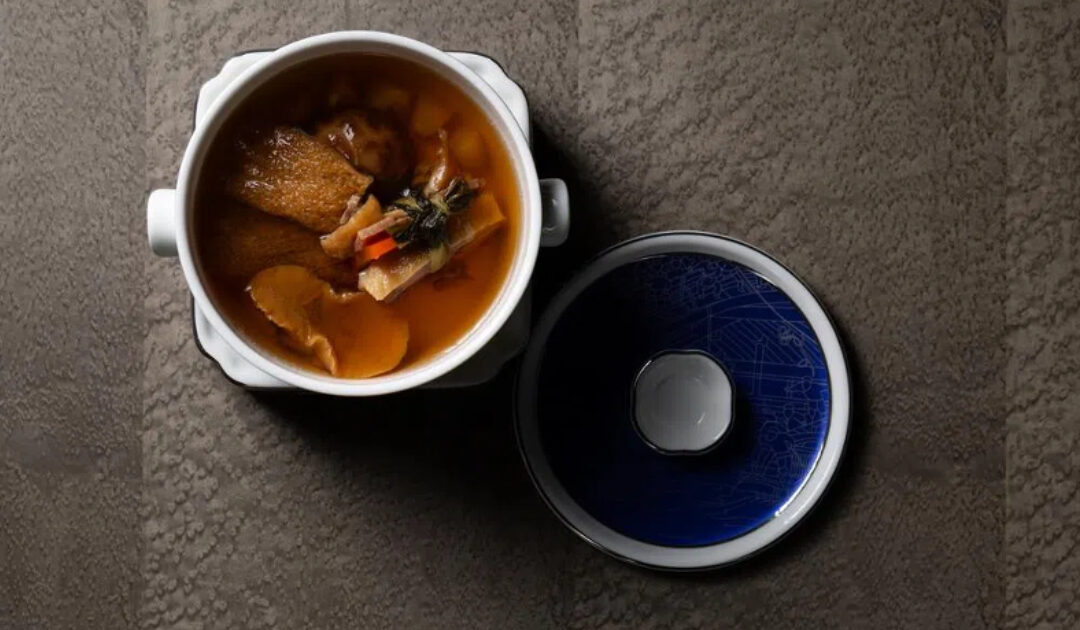
Ask a Cantonese cook which dish reveals the most about a kitchen and few will name the showpiece. Many point instead at the soup, a bowl that looks like almost nothing and takes longer to make than anything else on the menu.
Our Double-Boiled Chicken Soup with Abalone and Dried Red Mushroom, 红菇鲍鱼炖鸡汤, is that bowl. Set beside the roast meats and the wok dishes it asks for very little attention, and yet it occupies the stove for most of the morning. Double boiling is the reason, and the technique sits at how Chef Dee Chan thinks about nourishment.
How Double Boiling Works
Ingredients go into a lidded ceramic pot. That pot then sits inside a larger vessel of simmering water, so the broth never touches direct heat and never reaches a rolling boil. Hours pass. Four is common and six is not unusual.
The gentleness is the whole point. A hard boil agitates proteins and clouds the liquid, while steam-driven heat coaxes flavour out slowly and leaves the broth clean on the palate. Almost nothing evaporates, because the pot stays sealed, so the finished soup holds everything that went into it. In our version, the dried red mushrooms give up their colour over those hours, turning the broth a deep amber that has nothing to do with browning or reduction.
Nothing about the process can be hurried, which is why the method survives only in kitchens willing to plan a day ahead.
What Goes In
A double-boiled soup is built more than it is cooked, and each element in ours has a job:
- Old chicken, for the body and the gelatine that gives the broth its weight
- Dried red mushroom, prized in Cantonese and Hakka tonic cooking, for an earthy sweetness and the soup’s colour
- Abalone, for a savoury depth that arrives late and lingers
- Aged tangerine peel, for a faint bitterness that lifts the whole bowl
- Chinese yam, for a clean, almost mineral sweetness
Other households and other kitchens build theirs differently. Cordyceps flower, conpoy, fish maw, lotus root, and almond with apricot kernel all belong to the same tradition, and combinations shift with the season. Cooler months lean towards warming roots and darker broths, while the middle of the year calls for something lighter. What stays constant is the patience.
Why It Belongs on a Fine Dining Menu
Slowness is expensive. A pot set on the stove hours before the doors open at 11.30am cannot be hurried along for a table that sits down at noon, which is why so many kitchens quietly let the method go.
We keep it at 黑珍珠 The Black Pearl because it says something about our ‘Yue’ cuisine, the refined Cantonese cooking drawn from the Guangzhou, Hong Kong, Chaoshan and Dongjiang traditions. Technique inherited from home kitchens sits comfortably beside contemporary plating, an idea we have explored before through Cantonese cuisine: heritage meets innovation. A soup course also does useful work across a long meal, resetting the palate before the heavier dishes arrive, which is why our set lunch promotion opens with one on the days it appears.
Guests in our rooftop private dining rooms often notice it most, since a quieter room leaves space for a dish this understated to register.
The Case for Sitting Still
A double-boiled soup asks for patience from the kitchen and rewards the same from the table. Come a little early, order the 红菇鲍鱼炖鸡汤 to open the meal, and let everything that follows unfold from there. Reserve your table and taste what six unhurried hours can do.